
Frontiers in BioImaging 2018
Frontiers in BioImaging 2018
Scientific Organisers: Susan Cox, King's College London; Sian Culley, University College London; Gail McConnell, University of Strathclyde; Brian Patton, University of Strathclyde; Alex Sossick, University of Cambridge and Imogen Sparkes, University of Bristol
Frontiers in BioImaging 2018 will focus on the latest developments in applications of optical microscopy, mesoscopy and image analysis across a range of biological fields. Sessions will cover technical developments and applications of these microscopy-based approaches to key cell and molecular biology questions. The meeting will cover the key challenges in microscopy today: super-resolution imaging, phototoxicity and light sheet based methods, detection of in situ protein interactions and new tools for fluorescence visualisation and analysis.
This is an ideal meeting for both new and established researchers to engage with a broad range of imaging approaches and to make valuable contacts with leading groups in the field. There will be an exhibition held alongside this meeting, where the tea, coffee, lunch and posters will all be held. We are very grateful to the exhibitors and their support.
Registration has now closed for this meeting.
Programme & Poster List
Poster List
The winners of the poster prize competition, sponsored by Zeiss, are as follows:
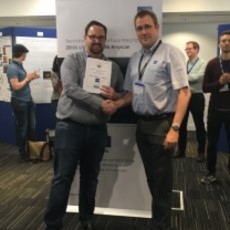
- 1st Prize - Conor Treacy, King's College London - Mechanosensitive protein-protein interactions in nascent focal adhesions determined by FRET sensing using multiphoton fluorescence lifetime imaging.
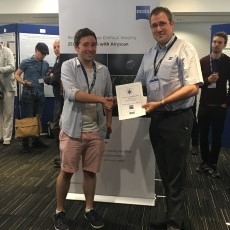
- 2nd Prize - Liam Rooney, University of Strathclyde - Applying the Mesolens to Microbiology Investigating the Structural Organisation of Bacterial Biofilms
|
From confocal microscope to virtual reality; technical and educational considerations – Craig Daly, University of Glasgow |
|
The spatial distribution of cardiac ryanodine receptor phosphorylation investigated using super-resolution microscopy – Carl Harrison, University of Exeter |
|
Characterisation and calibration of a 3D super-resolution microscopy system – Lucas Herdly, University of Strathclyde |
|
Nanodiamonds and adaptive optics for deep tissue super-resolution microscopy – Graeme Johnstone, University of Strathclyde |
|
Single-Molecule Instantaneous Velocity Measurement with a sCMOS Camera Operated in the Ultrafast Double-Exposure Mode – Mirella Koleva, King’s College London |
|
Attenuation-compensation techniques for overcoming losses in light-sheet microscopy – Jonathan Nylk, University of St Andrews |
|
New insights into one/two-photon properties of mScarlet fluorescent protein, its versatile use in living and fixed cells and tissues and in organoids – Ralf Palmisano, OICE |
|
Applying the Mesolens to Microbiology Investigating the Structural Organisation of Bacterial Biofilms – Liam Rooney, University of Strathclyde |
|
Elucidation of Bacterial Motility Dynamics using Interference Reflection Microscopy - Liam Rooney, University of Strathclyde |
|
A computational method for extracting 3D information from standing wave images of red blood cells – Ross Scrimgeour, University of Strathclyde |
|
The development of an OPTIMUM microscope for the applications in cellular biology and life sciences – Tiehan Shen, University of Salford |
|
Development of a flexible light sheet fluorescence microscope for cardiac cell imaging applications – Hugh Sparks, Imperial College |
|
Automated interpretation of time-lapse quantitative phase image by machine learning – Lenka Štrbková – Central European Institute of Technology |
|
Standing wave microscopy of red blood cell membrane morphology with high temporal resolution – Peter William Tinning, University of Strathclyde |
|
Mechanosensitive protein-protein interactions in nascent focal adhesions determined by FRET sensing using multiphoton fluorescence lifetime imaging – Conor Treacy, King’s College London |
|
Entertaining (with) E. coli O157 - Kath Wright, The James Hutton Institute |
Speakers
Democratising live-cell high-speed super-resolution microscopy
Quantitative imaging of structure and dynamics in biological transport networks
-

Dr Mark Fricker
Department of Plant Sciences, University of Oxford
Mark Fricker started as a plant physiologist with Colin Willmer in Stirling on dissecting signal transduction pathways in stomatal physiology, and then quantitative imaging of Ca2+ in Edinburgh with Tony Trewavas and Nick Read. He continued with in vivo imaging of Ca2+, pH and redox dynamics in plant and then fungal systems after the move to Oxford sometime last century, which evolved into the current interest in signalling and transport in networked systems, and an IgNobel prize in 2010. Experimental investigations cover a range of scales including confocal ratio imaging on a micron scale, radiolabel scintillation imaging at an intermediate scale, and network analysis and mathematical modelling to predict behaviour across all scales. As part of this work, he has been developing image analysis methods to quantify network architecture, dynamics and internal flows at different organisational scales, including sub-cellular ER networks, and macroscopic networks, such as fungi, slime molds, and leaf veins. The resultant fully-weighted network graphs then provide the input to predictive biophysical models to probe the mechanisms leading to the emergence of self-organised, adaptive behaviour.
Strategies for mesoscale imaging of non-transparent samples
Elastic properties of fibrous proteins and tissues probed Brillouin microspectroscopy
-

Dr Francesca Palombo
University of Exeter
My research is focused on the development of FTIR, Raman and Brillouin spectroscopy methods for applications to the biomedical sciences. I am particularly interested in the physical and chemical aspects of biological systems at a molecular level, as well their implications in disease. Previously, I developed the application of ATR-FTIR imaging to atherosclerosis in small animal models. I applied both ultrafast OHD-OKE and THz Raman scattering to elucidate the dynamics, structure and interactions in ionic solutions. My PhD was focused on H-bonding properties of octanols from the liquid to supercritical fluid phase using FTIR and Raman spectroscopy.
Imaging actin dynamics and interactions
-

Professor Maddy Parsons
RMS Honorary Secretary Biological Science
King's College London
Maddy is Professor of Cell Biology at King’s College London. Maddy completed her PhD in Biochemistry within the Department of Medicine at University College London in 2000. During her PhD she analysed the role of mechanical forces in dermal scarring. She then moved to Cancer Research UK laboratories in London for a 4-year postdoctoral position where she used advanced microscopy techniques including FRET/FLIM to dissect adhesion receptor signaling to the actin cytoskeleton and how this controlled directed cell invasion. Based on these achievements, Maddy was awarded a Royal Society University Research Fellowship in 2005 to establish her own group within the Randall Division of Cell and Molecular Biophysics at King’s College London.Following completion of her fellowship, Maddy was appointed Reader at King’s in 2013 and Professor of Cell Biology in 2015. Maddy has established collaborations with developmental biologists and clinical researchers to study adhesion receptor signalling in skin blistering, wound healing, inflammation and cancer. She works closely with physicists, biophysicists and other world-leading cell migration groups in the field to develop and apply new imaging technologies to dissect spatiotemporal cytoskeletal signalling events in live cells, tissues and whole organisms. As a result of her interest and applications of advanced microscopy, Maddy developed a strong working partnership with Nikon, which subsequently led to the establishment of the state-of-the-art, world-class Nikon Imaging Centre at King’s College London of which she is Director. Maddy also currently works alongside other biotech and pharmaceutical companies to develop and apply advanced imaging approaches to basic mechanisms that underpin drug discovery.
How chromatin organises in mammalian cells - lessons from 3D super-resolution microscopy
-

Dr Lothar Schermelleh
University of Oxford
2003 PhD at the Ludwig Maximilians University Munich (Advisor: Prof. Thomas Cremer)
2003-2011 Postdoctoral Researcher / Lecturer (Epigenetics & Bioimaging); Faculty of Biology, Ludwig Maximilians University Munich (Advisor: Prof. Heinrich Leonhardt).
2005-2007 Visiting Scientist with Prof. John W. Sedat, University of California, San Francisco.
Since 2011 Micron Senior Research Fellow / Principle Investigator at the Department of Biochemistry, University of Oxford
Multiphoton imaging across millimeter length scales with subcellular and subsecond resolution
-

Dr Spencer Smith
University of North Carolina - Chapel Hill
Spencer LaVere Smith earned is his undergraduate degree in physics and mathematics, and his Ph.D in neuroscience and neuroengineering. After postdocs at UCLA and University College London, he started his own lab at the University of North Carolina in 2011. Smith’s research uses state-of-the-art imaging, electrophysiology, and quantitative behavior to reverse engineer the neuronal activity dynamics that encode stimuli and guide behavior. His lab (slslab.org, labrigger.com) has developed novel multiphoton imaging instrumentation to measure neuronal activity across multiple brain areas simultaneously with subcellular resolution. His awards include a McKnight Technological Innovation Award (2015), a Klingenstein-Simons Fellowship (2013), and a Human Frontier Science Program Career Development Award (2012).
In vivo STED microscopy
-
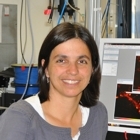
Dr Katrin Willig
Center for Nanoscale Microscopy and Molecular Physiology of the Brain, Göttingen
Katrin Willig studied Physics at Würzburg University and the University of New Mexico, Albuquerque, before joining Stefan W. Hell’s research team at the Max Planck Institute for Biophysical Chemistry in Göttingen in 2002. She graduated with a PhD from Heidelberg University in 2006 with a thesis on STED microscopy in the visible range. Since 2014 she has been leading her own junior research group at the Göttingen Cluster of Excellence and DFG Research Center for Nanoscale Microscopy and Molecular Physiology of the Brain (CNMPB) located the Max Planck Institute of Experimental Medicine in Göttingen. She pioneered the use of fluorescent proteins for nanoscale imaging of living cells and has developed STED microscopy for imaging tissue inside living organs. She has demonstrated the strength of these technologies by in vivo imaging of the tiny protrusions (dendritic spines) on nerve cell dendrites found in the synapses inside a living mouse brain with unprecedented detail.
Delegate Information
Admittance to this event is for registered and authorised attendees. Unfortunately we cannot permit access to visitors or allow non-registered persons to enter the meeting or exhibition areas. If you have any questions, please contact the RMS contact for this event.
Registration has now closed.
Registration fees
RMS Member £320
Non-member £370
Student £220
Conference Dinner
On Wednesday 27 June there will be a conference dinner at a local restaurant called the Drygate. The dinner is included in the registration fee for the Meeting.
An email will be sent to you two to three weeks before the event with final details.
Venue
Frontiers in BioImaging will take place at the Technology & Innovation Centre (TIC), University of Strathclyde, Glasgow. For travel information please refer to the webpage
Accommodation
The nearest hotel is Premier Inn, Glasgow City Centre (George Square), 187 George Street, Glasgow G1 1YU. For other hotel suggestions please visit here
Sponsorship
-

3i-Intelligent Imaging Innovations
3i designs and manufactures technologies for living cell, live cell, and intravital fluorescence microscopy including digital holography, spinning disk confocal, multi-photon and lightsheet. Over 1000 customers worldwide use 3i's SlideBook microscopy software to manage everything from instrument control to image capture, processing and data analysis. Established in 1994, 3i is headquartered in Denver, Colorado (USA) with offices in London, United Kingdom, and Göttingen, Germany.
Find out more about 3i (Intelligent Imaging Innovations)
www.intelligent-imaging.com -

CoolLED
CoolLED designs and manufactures cutting edge LED illumination systems for researchers and clinicians using the latest LED technology. The company has specialised in fluorescence microscopy since it introduced the first commercially available LED illumination system in 2004. LEDs are now the system of choice because they are more stable, longer lasting, and energy efficient than traditional mercury based illuminators as well as offering superior safety and environmental features.
CoolLED offers a comprehensive range of LED illumination systems for bioscience and clinical microscopy including:
• pE-100 range of compact, simple-to-use, single wavelength illumination systems for screening fluorescence.
• pE-300white range that offers intense, broad spectrum illumination covering the excitation bands of common fluorescent stains for regular fluorescence work.
• pE- 4000 – the universal LED illumination system for research fluorescence, with the broadest spectrum of illumination available from 16 selectable wavelengths, and extensive functionality that sets a new standard for the industry.
CoolLED technology is also available in OEM and tailor made configurations. We can meet the needs of manufacturers who wish to integrate stable, controllable LED illumination into their products.
Find out more about CoolLED
www.coolled.com -

Hamamatsu Photonics
Hamamatsu Photonics is a world-leading manufacturer of opto-electronic components and systems and employs over 3000 staff worldwide. The corporate headquarters are based in Hamamatsu City, Japan along with various manufacturing plants and central research laboratories. Since its inception in 1953, Hamamatsu Photonics has expanded to now enjoy a global presence throughout Asia, Europe and North America.
Hamamatsu Photonics’ corporate philosophy stresses the advancement of Photonics through extensive research and development. Hundreds of new opto-electronic products are introduced to the market each year and many Hamamatsu products are regarded as state-of-the-art. Hamamatsu sources, detectors and imaging products are designed to cover the entire optical spectrum, from nuclear radiation, x-ray, Ultraviolet (UV), Visible and Infrared radiation. Hamamatsu devices provide solutions for a wide variety of applications including analytical, industrial and medical instrumentation.
Find out more about Hamamatsu
www.hamamatsu.com -

Leica Microsystems
Leica Microsystems develops and manufactures microscopes and scientific instruments for the analysis of microstructures and nanostructures. Ever since the company started as a family business in the nineteenth century, its instruments have been widely recognized for their optical precision and innovative technology. It is one of the market leaders in compound and stereo microscopy, digital microscopy, confocal laser scanning microscopy with related imaging systems, electron microscopy sample preparation, and surgical microscopes.
Leica Microsystems has seven major plants and product development sites around the world. The company is represented in over 100 countries, has sales and service organizations in 20 countries, and an international network of distribution partners. Its headquarters are located in Wetzlar, Germany.
Find out more about Leica Microsystems
www.leica-microsystems.com -

Olympus
Olympus supplies a complete range of microscopy instrumentation and related software including upright, inverted and stereo microscopes. From teaching laboratories to national research establishments, all types of users are catered for - with everything from lens tissues to specialised imaging systems and advanced microscopy techniques.
Olympus microscopes are recognised for their world leading optics, ensuring unbeatable image quality from standard techniques to laser confocal microscopy, TIRF and live cell imaging. While some Olympus products focus on configurability to specific applications, others aim to maximise simplicity and relisability in multi-user environments.
The product range also covers digital microscope cameras and virtual slide systems, together with imaging equipment and software for general and specialist applications across Life Science and Industry.
Find out more about Olympus
www.olympus.co.uk -

Teledyne Photometrics
Founded as Photometrics in 1978, Teledyne Photometrics is part of the Teledyne Imaging Group. Teledyne Photometrics is the world’s premier designer and manufacturer of high-performance CMOS, EMCCD and CCD cameras for life science research. The original architect of the world’s first scientific-grade microscopy EMCCD camera and developer of the popular CoolSNAP CCD cameras, Teledyne Photometrics maintains its leadership role with the release of Prime, the first sCMOS camera with built-in computational intelligence for image restoration, and Prime 95B, the first sCMOS camera with 95% quantum efficiency. Teledyne Photometrics also offers comprehensive OEM support, including fully characterized, cost-efficient imaging systems and components. Teledyne Photometrics is headquartered in Tucson, Arizona.
Find out more about Teledyne Photometrics
www.photometrics.com -

Photon Lines
Photon Lines supplies a range of scientific cameras (including CCD cameras, CMOS and sCMOS), lasers and laser components which are optimised for Lightsheet microscopy. We also supply advanced scientific imaging solutions primarily into the area of biophotonics, such as Label-Free Live Cell Imaging Systems and fluorescence microscopy equipment including the products of PhaseView, who have engineered unique 3D imaging technologies for life science microscopy applications. Based on a novel remote focusing principle, PhaseView imaging products allow for high speed 3D imaging which is only limited by camera frame rate, while keeping bio-specimens in a stable position without moving the objective or stage. Using this acquisition principle, PhaseView’s Alpha3 light sheet fluorescence microscope addresses the issue of high temporal resolution along with spatial high-resolution, to achieve 3D imaging of dynamic biological processes.
Find out more about Photon Lines
photonlines.co.uk