
Sponsored Content: 4D-STEM Comes of Age at IMC21
As researchers gather in Liverpool for IMC21, one of the clearest trends emerging across the scientific programme is the growing importance of 4D-STEM. Once regarded as a specialist technique, it is now becoming a core workflow for investigating the structure and behaviour of materials at the nanoscale.
Unlike conventional STEM imaging, 4D-STEM records a complete diffraction pattern at every probe position as the electron beam scans across a specimen. This rich dataset allows researchers to extract detailed crystallographic information, including crystal orientation, phase distribution and local lattice distortions, alongside conventional imaging data.
A key enabler of this transformation has been the combination of fast pixelated detectors with precession electron diffraction (PED), which produces diffraction patterns that are easier to interpret and more robust for automated analysis. These advances have made orientation and phase mapping faster, more accurate and applicable to increasingly complex materials.
NanoMEGAS' ASTAR® platform is one example of how these developments have matured into practical research workflows. By combining PED with automated orientation and phase mapping, ASTAR enables high-resolution crystallographic characterisation across a wide range of applications, from advanced alloys and semiconductor devices to battery materials, geological specimens and nanomaterials.
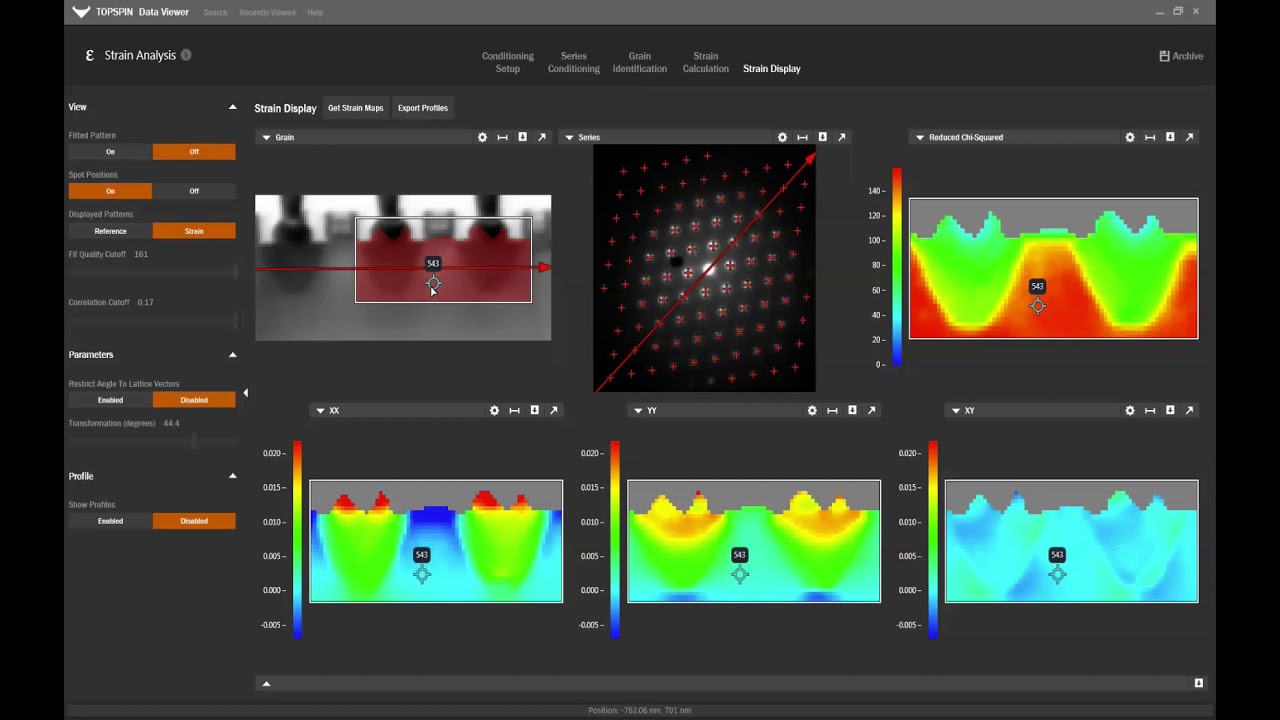
Beyond orientation mapping, the expanding NanoMEGAS software portfolio enables researchers to extract even more value from diffraction data. Dedicated tools support applications including 3D Electron Diffraction (3D ED) tomography for solving crystal structures from nanocrystals, electron pair distribution function (ePDF) analysis for amorphous and nanostructured materials, and advanced diffraction data processing to deliver quantitative insights from increasingly complex datasets.
The broad adoption of 4D-STEM is reflected in the IMC21 scientific programme, where diffraction-based techniques feature prominently in sessions covering functional materials, electron crystallography, in situ microscopy and data-driven analysis. Dedicated workshops exploring 4D-STEM acquisition and interpretation further highlight the technique's transition from an emerging capability to an established tool in the microscopist's toolkit.
As detector technology, data processing and analysis algorithms continue to evolve, 4D-STEM is expected to play an increasingly central role in connecting imaging with quantitative crystallographic information. For researchers seeking to understand how structure influences material properties, orientation mapping is no longer simply an advanced option—it is becoming an integral part of modern electron microscopy.
Interested in learning more about practical 4D-STEM orientation and phase mapping?
Visit us on Stand 117 at IMC21.
You can also explore application notes and white papers on precession electron diffraction and learn more via Quantum Design UK and Ireland, official distributors of NanoMEGAS in the UK and Ireland.